

Today, when users ask questions to AI models like ChatGPT, Gemini, or Perplexity. Instead of showing ten blue links, these systems provide direct answers, and inside those answers they select which brands to recommend or reference.
This creates a new form of online visibility driven by how AI interprets a brand, not just by how search engines crawl it. Therefore, your brand needs to be understood clearly enough for AI to summarize you correctly, or risk being replaced by another competitor that appears more relevant.
This emerging discipline is known as Generative Engine Optimization (GEO).
What Reverse Prompts Are – and Why They Matter
Under the discipline, reverse prompting is a method where we ask an AI model to describe a company based on small pieces of text, such as a short hyperlink description, a snippet from a product list, or a reference on another website.
Instead of feeding long descriptions, we provide minimal information so the AI can make its best “guess” from public patterns it has learned.
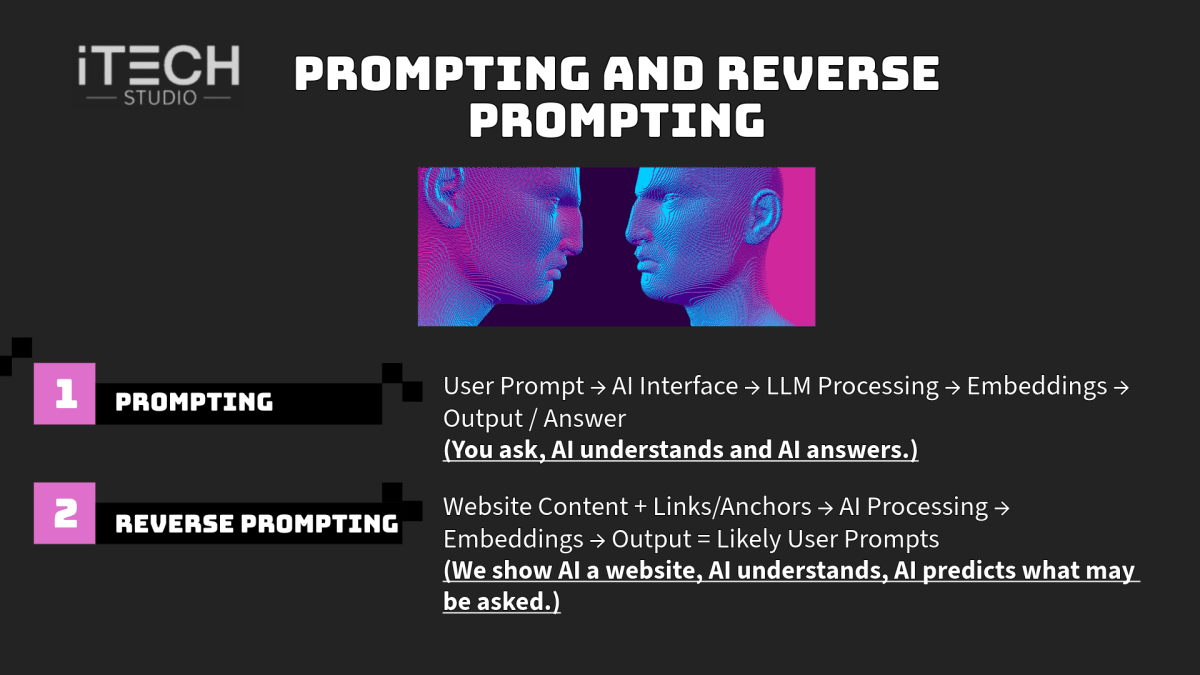
This process reveals how AI systems might summarize your brand for users. It can highlight your perceived industry strengths, your core offerings, or your target market.
It can also expose unclear branding when the AI cannot describe you confidently.
Reverse prompting does not produce a definitive opinion, but it shows how AI may speak about you to thousands of users, making it a useful reflection tool.
How to Run a Reverse Prompt (Beginner-Friendly Method)
You do not need advanced coding skills to do this. The process starts with collecting small pieces of publicly available text about your brand – especially text from other websites.
These can be blog mentions, directory listings, customer reviews, news snippets, or short product descriptions.
After gathering these snippets, they can be extracted manually or with tools like Screaming Frog. Once collected, each snippet is fed into an AI system with a question such as:
“Based only on this short text, how would you describe this brand, its services, and its target audience?”
Reverse Prompting Guide
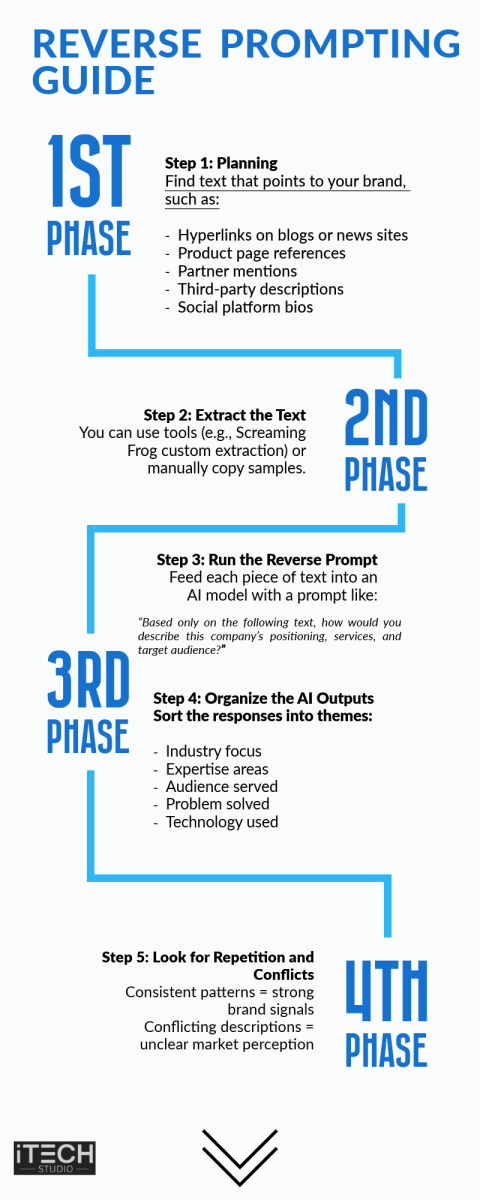
The AI will generate summaries, which we then organize. The goal is to study how consistently the brand is described.
If many outputs repeat similar descriptions, it signals strong clarity. If descriptions vary drastically, it may indicate unclear positioning or scattered messaging online.
The New Reality of Brand Visibility (SEO + GEO)
Traditional SEO focuses on optimizing keywords, technical structure, and rank positions. It tries to place a website higher on search engine results pages so users click through to learn more. GEO, however, asks a different question: does AI recommend you even if the user never clicks anything?
With AI assistants answering queries directly, visibility now depends on whether your brand becomes a “default choice” inside an AI’s answer.
This shifts optimization from simply ranking content to strengthening how your brand is referenced and understood across the web. It requires clearer narratives and consistent third-party signals, not only optimized metadata.
More info on why GEO functions differently from SEO in terms of metrics and how it is optimised here:
GEO Made Simple
How to Track “Success” in GEO
Unlike SEO, GEO does not have one universal ranking page you can monitor (yet).
However, there are practical ways to measure whether things are improving. The most important indicator is how often your brand appears inside AI-generated answers.
You can test this by asking AI questions related to your industry and seeing whether your brand is named.
Another useful measure is whether multiple AI systems – not just one – describe your business consistently. If they highlight similar strengths, audiences, or services, it means that your brand signals across the web are clear enough to affect machine interpretation.
Over time, you can also watch whether more question-type searches lead indirectly to your brand (e.g., “best service for ___”), even if users do not search your name directly.
For more advanced tracking, topic clusters and embeddings can be analyzed to see how “strongly connected” your brand is within certain subject areas. This helps determine whether an AI engine views you as part of a category or as a replaceable option.