

While Search Engine Optimisation (SEO) has long been the foundation of digital visibility, the rise of Generative Engine Optimisation (GEO) marks a new era – one where brands are optimised not just for search engines, but for AI-driven discovery.
Below, we break down the core differences between SEO and GEO – specifically in how they are measured and improved.
1. Differences in How They Are Measured
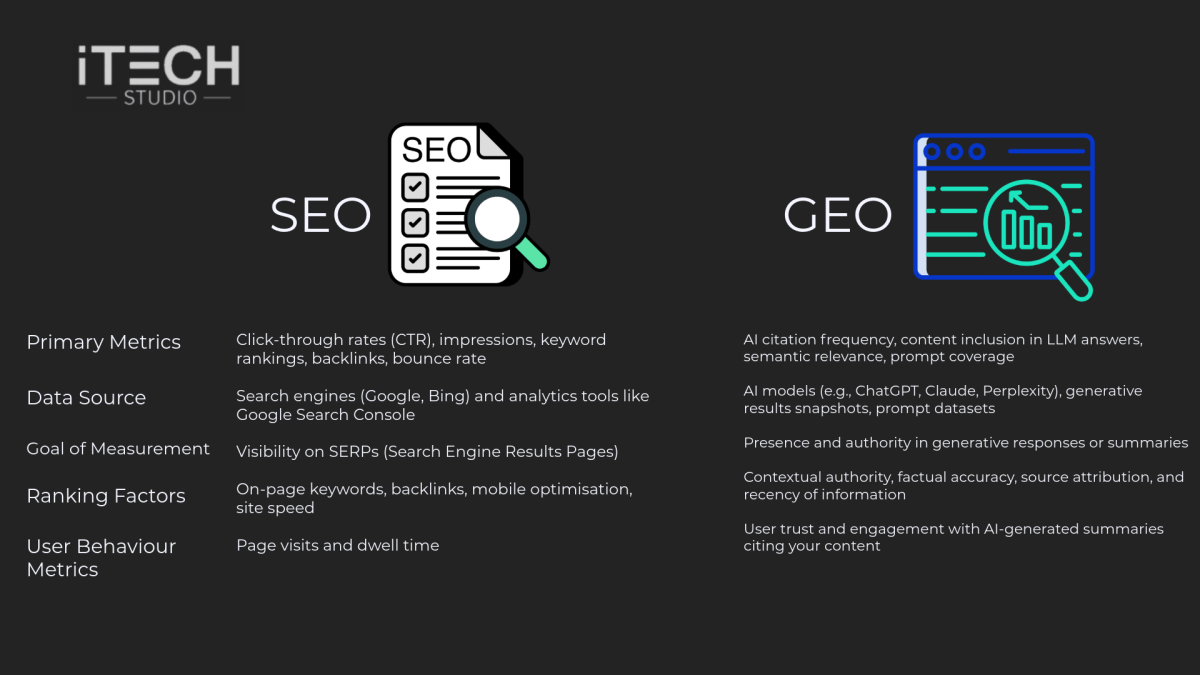
In SEO, success is measured by how high your website appears on search engine result pages and how users interact with those listings.
In GEO, the focus shifts toward how frequently your brand, data, or article is referenced or cited by AI models when users ask related questions.
Instead of “ranking for a keyword,” GEO tracks your influence within AI-generated content – how often and confidently models select your content as a trusted source.
2. Differences in Corrective and Optimisation Actions
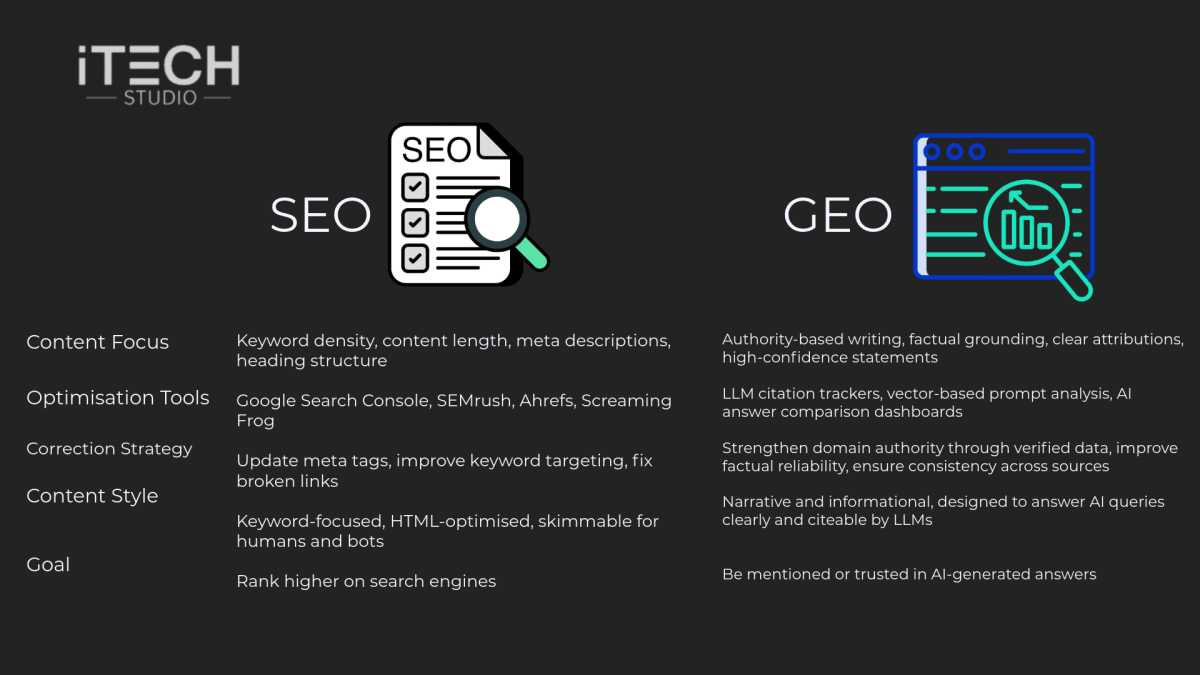
If SEO discovers a drop in ranking for “best math tuition in Singapore,” the fix might be to rework your content’s meta title or improve backlink quality.
If GEO shows a drop in AI citations for “trusted tuition centres,” the fix could be to publish a more data-backed article (e.g., include referenced statistics or outcomes) so LLMs recognise it as authoritative.
3. Where They Overlap
While SEO and GEO approach optimisation from different angles, they share the same foundation: creating content that truly serves users. Both value quality writing, built with clarity and purpose.
This means no keyword stuffing, filler phrases, or repetitive padding – just content that communicates ideas directly and informatively.
Whether for Google’s crawlers or AI’s reasoning models, clarity always wins.
Other factors to consider
- Another key principle is authority and credibility. Both SEO and GEO reward content that comes from trustworthy, well-established sources – articles that are cited, data-driven, or backed by genuine expertise. In traditional SEO, this builds domain authority; in GEO, it builds semantic trust, signalling to AI engines that your content deserves to be quoted or summarised.
- Both systems prioritise recency and expertise. Up-to-date, factual content tells both search engines and AI models that your site is active, informed, and reflective of the latest trends or research in your field.