

The world of search is changing faster than ever.
We’ve moved beyond the days when ranking first on Google was the ultimate goal.
Now, with AI-driven search and generative engines like ChatGPT, Gemini, and Claude, a new frontier has emerged – one where content is not just ranked, but read, understood, and cited by AI systems themselves.
Welcome to the age of Generative Engine Optimisation (GEO).
–
What Is Generative Engine Optimisation?
GEO is the process of optimising your content not just for keywords and links, but for AI understanding.
Think of it as SEO for the age of AI assistants – where users don’t just click on links but ask questions like:
“What’s the best “xxx product”?”
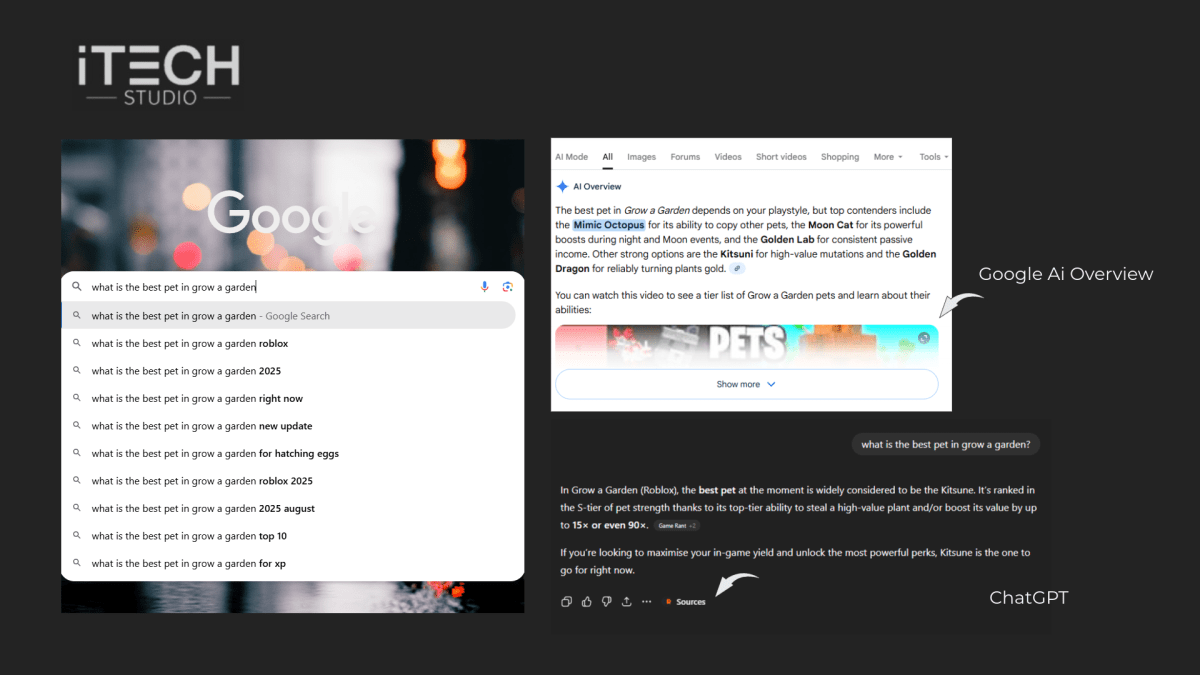
Instead of showing a list of results, the AI might generate an answer, pulling in references from trustworthy, structured sources – the ones it understands best.
That’s what GEO is about: helping AI recognise your content as credible, relevant, and ready to be cited.
Reverse Prompting: Speaking the AI’s Language
One of the first steps in GEO is something called reverse prompting.
Reverse prompting is the process of working backwards from how AI systems generate answers to understand what kinds of content they prefer – and then crafting your content so that it’s more likely to be cited or surfaced by those AI models.
Instead of thinking like a search user typing keywords (traditional SEO), you think like the AI model generating the answer.
Instead Of:
“What keywords do people type into Google?”
– SEO
We now ask:
“How would someone ask an AI assistant about this topic?”
– GEO
Reverse prompting helps us align our content with the natural language patterns of AI-driven search – focusing on intent, context, and semantic relationships.
Going Beyond Reverse Prompting – iTechStudio’s Approach
At iTechStudio, we wanted to go a step further.
Reverse prompting is powerful, but it’s still reactive – you’re predicting prompts.
We wanted to see how AI itself perceives our clients’ content.
Embedding and Cosine Similarity
To make sense of how AI “reads” and organises information, we need to look at two key concepts: embeddings and cosine similarity.
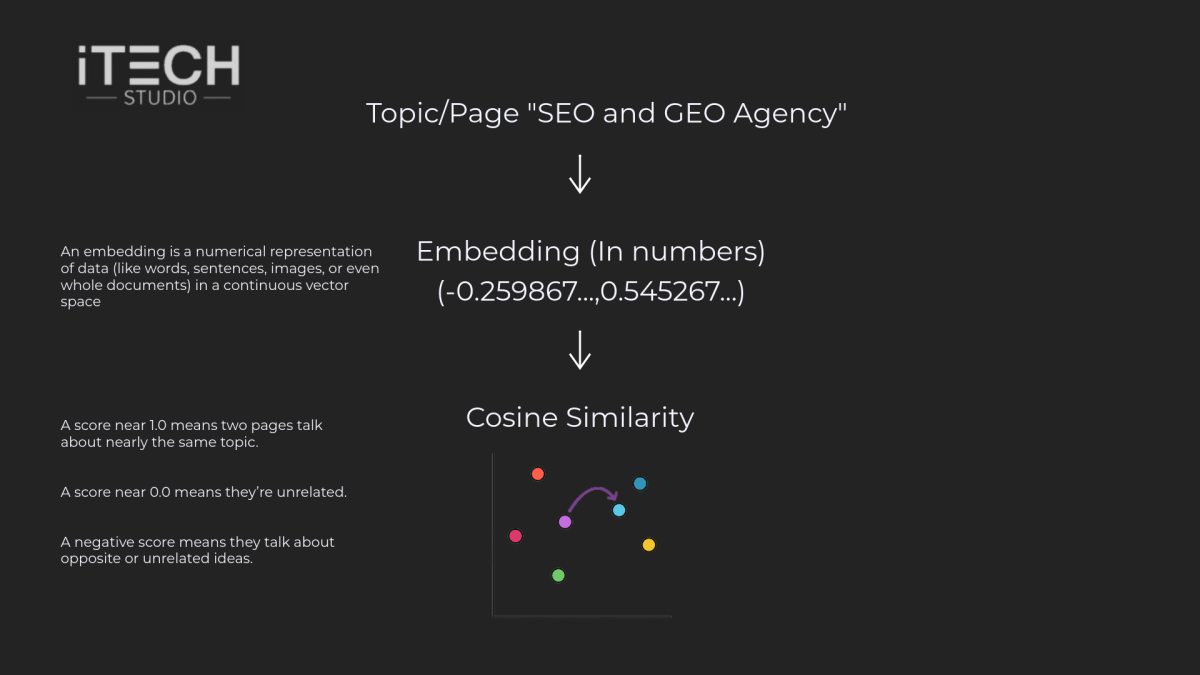
Imagine every piece of online content – a blog post, a product page, a social post – being turned into a point in a huge, invisible space. AI models don’t understand words the way humans do; they understand relationships between meanings. So they convert each sentence or paragraph into a long string of numbers called an embedding.
These embeddings act like coordinates that describe meaning – not spelling or grammar, but conceptual closeness. Two pieces of content that talk about similar ideas (for example, “how to grow succulents” and “succulent care tips”) will sit close together in that space, even if they use different words.
Cosine Similarity
That’s where cosine similarity comes in.
It’s a mathematical way of measuring how close two embeddings are in direction – how similar their meanings are.
- A score near 1.0 means two pages talk about nearly the same topic.
- A score near 0.0 means they’re unrelated.
- A negative score means they talk about opposite or unrelated ideas.
By analysing these relationships, we can map out content clusters – groups of pages that share the same theme or intent.
Content Cluster
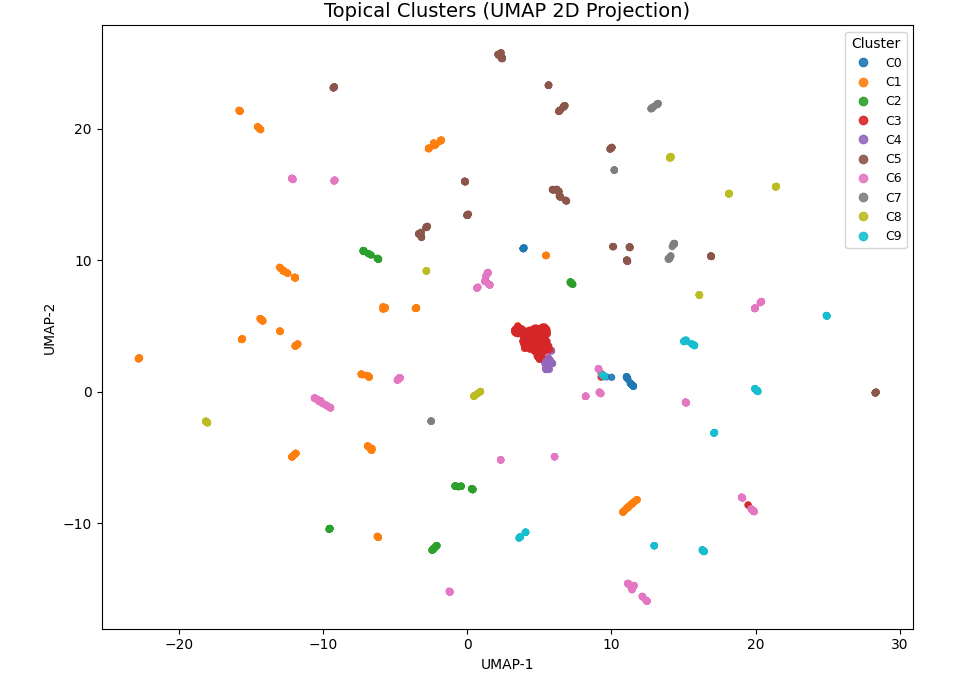
GEO: Content Cluster UMAP
This allows us to measure how semantically close different pages are, and how “understandable” their clusters appear to an AI model.
1. Each page on a website becomes a vector (a list of numerical values).
2. We compare those vectors using cosine similarity, which tells us how close in meaning they are.
3. Pages with strong relationships (0.8 similarity or higher) form content clusters – the same kind of “concept map” that AI models use internally.
By analysing these clusters, we can see where a brand’s topical authority is strong, where it’s fragmented, and how “fan queries” – related subtopics or questions – might connect under that cluster.
From Meaning to Metrics: Turning AI Understanding into Strategy
This approach has turned GEO from a buzzword into something measurable.
We don’t just tell clients “write for AI.”
We show them, with data, how their content is positioned in AI’s semantic landscape.
In our internal benchmarks, clients whose content clusters had an average cosine similarity above 0.8 saw a 30–40% improvement in visibility and AI citations within three months.
That’s not just SEO – (It’s partially GEO oriented) as well as search behaviour evolving in real time.
The Future of GEO
Generative Engine Optimisation isn’t about gaming algorithms anymore.
Fundamentally, the strategies are the same. It is about:
- Building authentic content for an audience.
- Building digital ecosystems that AI trusts.
For AI, as LLMs continue to shape how people discover, learn, and buy, we’re helping brands adapt – not by guessing prompts, but by mapping meaning with tools..
At iTechStudio, we’re excited to be part of that change – creating a future where your content doesn’t just get seen, but gets chosen by the AI engines that shape tomorrow’s web.
Ready to future-proof your digital presence?
Let’s build your Generative Engine Optimisation strategy today.
Get in touch with our GEO specialists to see how your brand can stand out in the age of AI search!