

Google’s September 2026 Spam Update: What Changed and What Site Owners Should Check
Updated 28 September 2026
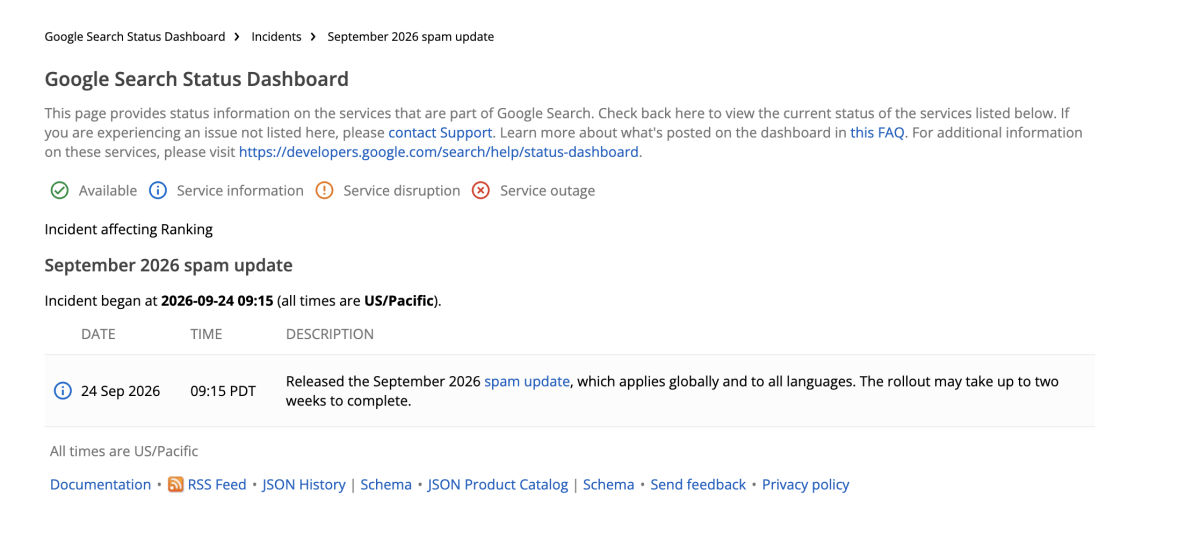
Google began rolling out its September 2026 spam update on 24 September at 9:15 a.m. Pacific time. It applies globally and to all languages. Google says the rollout may take up to two weeks, so ranking movements seen in the first few days should not yet be treated as the final outcome.
What does the update do?
A spam update improves Google’s automated systems for detecting practices that violate its Search spam policies. Google has not identified a particular tactic targeted by this September update. It would therefore be premature to claim that it specifically targets AI articles, backlinks, affiliate sites, or any one industry.
Google describes SpamBrain as one of its AI-based spam detection systems, but has not disclosed which systems changed in this rollout.
The distinction matters: using AI to help produce content is not, by itself, the issue described in Google’s policy.
Scaled content abuse concerns generating many pages primarily to manipulate rankings while offering little value to users, regardless of how those pages were made. Google also lists practices such as doorway pages, keyword stuffing, manipulative links, scraping, deceptive redirects, and site reputation abuse in its broader spam policies. These are areas to audit, not a confirmed list of targets for this update.
Where should the core fixes happen?
Start with the pattern behind a group of pages, rather than changing titles or adding words to every page that slips in rank.
Review scaled or overlapping pages. Check whether location, service, or keyword variations genuinely answer different needs. Consolidate pages that exist mainly to capture near-identical searches, and strengthen pages with useful, original information.
Audit content production. Identify large batches assembled from rewritten sources, generic AI output, or repeated templates without meaningful expertise, evidence, or user value. Decide which pages warrant substantial improvement and which should be excluded from Search.
Check links and sponsored content. Stop link arrangements made primarily to influence rankings. Qualify paid links appropriately with
rel="sponsored"orrel="nofollow".Inspect the site for abuse you did not create. Check for injected pages, unexpected redirects, spam comments, and compromised sections. Review Search Console’s Manual Actions and Security Issues reports as part of the diagnosis.
A normal redirect used to consolidate two useful pages is not a spam tactic. Google distinguishes legitimate consolidation from redirects intended to deceive users or search engines.
What ranking changes should we expect?
Sites affected by a spam system may rank lower or disappear from some results. Sites that become compliant may improve, but Google says its automated systems can take months to learn that a site now follows its spam policies.
There is (unfortunately) no guaranteed rebound when this rollout ends. If a future diagnosis establishes that lost visibility came from neutralised spammy links, removing those links does not restore the ranking benefit they previously supplied. Google has not labelled this September release a link spam update.
For an unaffected site, ordinary ranking fluctuations remain possible.
A drop beginning near 24 September is a reason to investigate, not proof of a spam violation. Technical errors, changes in search demand, and competitors can also move clicks.
How to assess your site during the rollout
- Mark 24 September on the Search Console performance chart and preserve a pre-update baseline.
- Compare the same queries, pages, countries, and devices across periods; look for a sustained loss across a clear page group rather than reacting to one keyword’s daily position.
- Check indexing and technical reports if the decline is site-wide.
- Reassess after Google confirms the rollout is complete and enough post-update data has accumulated. Google recommends examining the pattern of a traffic drop before deciding what needs to change.
For content-led businesses, the most useful response is a focused audit of why each page exists and what distinct value it provides. Fix a documented spam-policy problem promptly if one is found. Otherwise, continue the planned content and technical work while the rollout settles, and judge its impact from page-level evidence rather than the update’s name.