

If you’ve noticed your site suddenly slipping–or vanishing–from Google’s rankings, you’re not alone.
Recent changes in Google’s search algorithms have shaken up results across multiple industries, leaving many web owners searching for answers.
In this article, I’ll break down:
- What might have happened,
- Share practical strategies that different types of website owners can use to recover their visibility and rankings.
Why Rankings might have dropped from June 2025 Onwards

1. June 2025 Core Update & Resulting Volatility
Reason 1: The June 2025 Google Core Update introduced significant algorithm adjustments that led to noticeable ranking shifts across many industries.
* I have found rankings of some client sites falling from the top 10 positions to the 50th and 60th spot.
When was it rolled out?
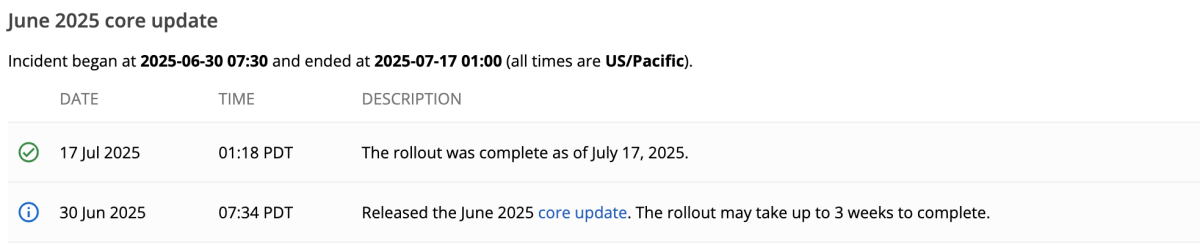
Google’s June 2025 Core Update rolled out from June 30 to July 17th and triggered widespread ranking shifts.
What was in the Google June Core Update?
Fundamentally, the core updates affected SEO in the following areas:
- Best practices for Image Indexing are clarified.
“Using standard HTML image elements helps crawlers find and process images.
Google doesn’t index CSS images.”
- URL structure standards are clarified.
Keep the URL readable and avoid long strings of numbers for easy navigation and crawlability.
- For countries with access to Google’s pilot AI mode search query (US, UK and India), searches from this mode are counted into the overall traffic in Google Search Console.
AI Overviews help people get to the gist of a complicated topic or question more quickly, and provide a jumping off point to explore links to learn more. They were designed to show up on queries where they can add additional benefits beyond what people might already get on Search.
2. Trends Accompanying the Core Update
Reason 2: Shifts in Google’s Quality Signals
Beyond the technical turbulence from the June 2025 Core Update, Google has also been refining how it evaluates content quality. These refinements go beyond just keywords and backlinks–they place greater weight on who is creating the content, how credible it is, and whether it can be trusted for sensitive or high-impact topics.
Increased Emphasis on E‑E‑A‑T (Experience, Expertise, Authoritativeness, Trustworthiness)
Recent updates placed a heavier focus on content authenticity and expertise–particularly for YMYL (Your Money or Your Life) topics.
Small businesses may see sharp swings if their content doesn’t clearly communicate credentials, educator expertise, or structured value. Building stronger signals around local authority and trustworthiness is essential for stabilization.
Rise of AI Overviews & Zero‑Click Search Results
AI-generated content previews and zero-click SERP elements are growing – meaning even well‑ranked pages may receive less traffic. If Google chooses to feature AI Overviews in place of a site link, your visibility could temporarily suffer.
3. MUVERA Launch (June 2025)
Reason 3: The Impact of MUVERA
MUVERA (Multi-Vector Retrieval via Fixed Dimensional Encodings) was officially introduced by Google on June 25, 2025 via their Research Blog, alongside a detailed technical paper.
What Does MUVERA do?
MUVERA simplifies complex, multi-point comparisons into a single, quick-to-search format. It does this through a process called Fixed Dimensional Encodings, which compress multiple layers of meaning into one efficient “summary.”.
For a Non Technical person:
** Think of search like a librarian pulling relevant books.**
Traditional search looked at one summary for each page; MUVERA uses many summaries–so it understands content more deeply.
Why This Affects SEO
This lets Google retrieve content faster and more accurately–especially for nuanced or long-form queries. But it also means that content must be semantically rich and relevant at a conceptual level–not just stuffed with keywords.
If your text doesn’t deeply answer the user’s question, it may never be retrieved in the first place. Similarly, if the content is not relevant between one another, that may also lead to a decrease in rank.
Some Methods you can take to Fix Rankings

| Strategy | Quick Fixes |
| Amplify E‑E‑A‑T | Publish instructor profiles, accreditations, testimonials, and real outcomes. |
| Enhance Content Depth | Focus on detailed, query-driven content (e.g., “Where to purchase xxx in a certain area”). Address specific pain points rather than general guides. |
| Optimize UX & Technical SEO | Improve page speed (Core Web Vitals), mobile design, structured data, and internal linking. Ensure usability and easy navigation. |
| Focus on Local SEO | Highlight your physical location (“Message at area xxx”), service area, local reviews, and consistent NAP (Name, Address, Phone) across listings. |
| Monitor, Tweak, and Wait | Ranking changes from core updates often stabilize over a few weeks–keep refining quality and relevance before expecting recovery. |
Steps To Take to Address Ranking Drops
- Monitor First
Before taking action, observe your site’s rankings for 3–4 weeks. Not every fluctuation requires immediate changes–some volatility is normal following a core update. Once you notice sustained drops, it’s time to implement a plan of action. - Use a Checklist Based on Common Issues
Based on the ranking problems discussed above, you can attempt fixes such as improving content authenticity, strengthening E‑E‑A‑T signals, and optimizing for MUVERA’s semantic retrieval.
Keep in mind that even after following this checklist, some pages may not immediately recover their previous positions. SEO is iterative and sometimes results take time. - Return to Core SEO Principles
If your site’s ranking issues aren’t resolved through the checklist, revisit the fundamentals:- On-Page SEO: Quality content, structured headings, internal linking.
- Off-Page SEO: Backlinks, domain authority, social signals.
- Technical SEO: Site speed, mobile-friendliness, crawlability.
Addressing as many of these areas as possible can improve the likelihood of recovery
Share Insights with the Community
Finally, SEO is a constantly evolving field. If you’ve seen rankings rebound after similar drops or discovered a solution not mentioned here, I would love to hear from you.
Drop me an email–I am interested in learning from everyone’s experience, whether you’re an SEO professional or not!